Distributed Energy Solutions
Make better
energy investment decisions.
Lower energy costs. Compare technologies. Find the sites worth pursuing. Connect your next business decision to the economics of battery storage, solar, and on-site generation.
Choose your starting point
Start with the decision in front of you.
You do not need to know the technology or the terminology yet. Start with the question you need to answer.
Lower energy costs
Find out whether battery storage and a fuller view of your electricity bill reveal a worthwhile savings opportunity.
Explore cost savingsEvaluate investments
Compare technologies, qualify a project, or take a closer look at the assumptions behind a proposal.
Explore investment decisionsPortfolio & markets
Identify where to focus across multiple facilities and understand how regional economics change the opportunity.
Explore portfolio & marketsDistributed energy resources, or DERs, are technologies such as solar, batteries, and on-site generators. The right starting point is the business question, not a preferred piece of equipment.
Look beyond the
headline electricity rate.
Start with the charges and operating patterns that shape your bill. Then explore whether a distributed energy investment could change the economics.
Different questions. One electricity bill.
A peak is a moment.
The economics are site-specific.
Connect the timing of demand to the charges on the bill. Then investigate the role that storage, operations, and dispatch could play.
Conceptual profiles, not measured load data or predicted savings. Actual results require site-level analysis.
Commercial Battery Storage ROI & Payback
Understand the inputs that shape a commercial battery business case, from installed cost and utility rates to operating assumptions and potential savings.
Commercial Demand Charge Reduction
Look beyond total electricity use. Explore how demand charges work, when peak reduction can help, and why your tariff and load pattern matter.
Battery Storage Value Stacking
Connect bill savings with eligible market programs and incentives. Separate potential value from compatible, accessible opportunities that can support the same project.
Compare the options.
Question the assumptions.
Before committing capital, connect the technology to your business objectives and identify what still needs to be proven.
Different capabilities.
A shared business case.
Evaluate technology fit, project readiness, and proposal assumptions together. Start with what the facility needs, then build the shortlist.
Examine available space, expected production, and how generation aligns with the facility's load and tariff.
Solar vs. Battery vs. Generator
Compare on-site technologies against your cost, reliability, and operating objectives. Build a shortlist based on the facility, rather than starting with a preferred solution.
DER Project Feasibility & Screening
Organize site inputs, examine the economics, and identify assumptions that need validation. Determine which opportunities deserve more engineering and commercial diligence.
Evaluate a Battery Storage Proposal
Review the proposed costs, dispatch strategy, tariff assumptions, and value streams. Ask better questions about the risks and exclusions behind a projected return.
Find where to focus next.
A strong opportunity at one facility does not automatically translate to another. Bring site differences and regional context into the same decision process.
A connected view of the opportunity
One framework.
Different site economics.
Make site differences visible before deciding where to focus. A common approach helps organize the next questions across facilities and markets.
Illustrative portfolio network, not customer sites, performance scores, or live market data.
Multi-Site DER Investment Screening
Bring a consistent framework to different locations, loads, and tariffs. Compare opportunities and focus development resources on sites that justify a deeper assessment.
Regional Distributed Energy Economics
Explore how market conditions, utility tariffs, and participation rules shape project economics across PJM, ERCOT, ISO-NE, and NYISO. Use regional context to guide site-level questions.
From question to action
A useful first step.
A better next decision.
Start with a directional view, then deepen the analysis around your site and objectives.
- 01
Frame your question
Clarify the problem, the facility, and what would make an investment worth pursuing.
- 02
Explore the economics
Use a free tool for an initial view or discuss site-specific analysis in the DECH platform.
- 03
Prioritize deeper diligence
Identify the opportunities and assumptions that need engineering, commercial review, or further validation.
Start with your electricity bill.
The Distributed Energy What-If Calculator provides a directional starting point for battery or solar-plus-battery exploration.
Open the What-If CalculatorInitial exploration, not a complete project financial model.
See the context with ValenceTM.
Explore regional market conditions and distributed energy value pathways before narrowing your focus to a specific site.
Open the Valence DashboardMarket context complements, rather than replaces, site-level analysis.
Analysis in practice
Real questions. More informed decisions.
A clearer multi-site
investment funnel
For a national consulting and development firm, DECH applied a consistent framework to solar opportunities across customer sites, supporting prioritization of engineering and development effort.
Read the Multi-Site Case StudyTechnology selection
before engineering
For a planned industrial facility, DECH compared distributed energy alternatives against site economics and reliability requirements, helping narrow the options for further diligence.
Read the Industrial Case StudyA few things to know
Not sure where
to begin?
Start with what you are trying to accomplish. We can help connect that question to the right next step.
Do I need to know which technology I want?
No. Start with your objective, such as reducing energy costs, evaluating reliability needs, or prioritizing a portfolio. The technology-comparison and feasibility pathways help organize the questions before you commit to a particular solution.
Is the free calculator the same as the DECH platform?
No. The free calculator is for directional exploration of a limited set of assumptions. The DECH platform supports a broader project-qualification workflow. A demo is the right next step for discussing your sites, technologies, and analysis needs.
Can DECH help with more than one site?
Yes. DECH supports multi-site screening so opportunities can be compared using a common analytical framework. The number of sites and uploads available depends on the subscription. Discuss your portfolio requirements during a demo.
Does screening replace engineering or final investment diligence?
No. Screening helps determine which opportunities warrant further work. Final decisions still require appropriate engineering, tariff and program validation, cost confirmation, and financial diligence. Potential value is not the same as a guaranteed outcome.
Your next energy decision
Start with a question.
Move forward with a clearer picture.
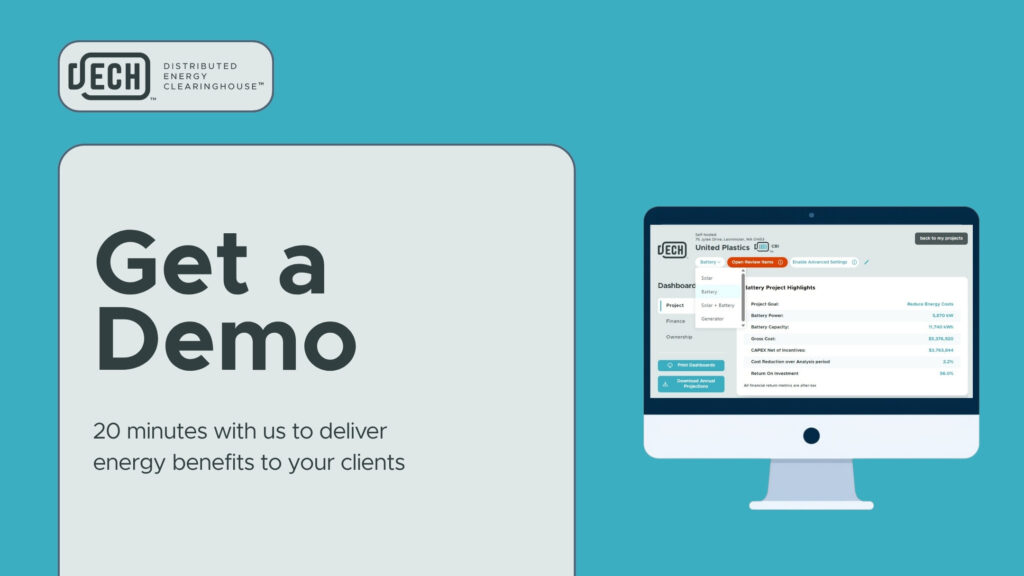
Bring your site, your portfolio, or your next project idea. See how DECH can help you decide what deserves a closer look.
For information and project qualification only. Potential savings, market participation, incentives, and reliability benefits depend on the site, technology, utility tariff, operating strategy, and eligibility. Screening is not a guarantee of performance or a substitute for detailed project diligence.