
Reliability generators are becoming an increasingly attractive investment in ERCOT, serving as both a backup power solution and a revenue-generating asset. This analysis compares three 1,000 kW generator scenarios to show how wholesale market conditions and outage assumptions can dramatically impact project economics.
Key Takeaways
- A 1,000 kW reliability generators in ERCOT can generate value from 9 different revenue streams.
- Using 2021 ERCOT pricing instead of 2023 pricing increased project NPV from $317K to $2.83M and ROI from 137% to 422%.
- Wholesale Energy Revenue more than doubled from approximately $135K/year to $300K/year under higher-price market conditions.
- Ancillary Services Revenue reached approximately $260K/year, making it one of the largest contributors to project value.
- Reducing the assumed outage cost from $100K to $25K annually lowered NPV by more than $500K and reduced ROI by nearly 60 percentage points.
- For ERCOT generator projects, the two most important assumptions are market prices and the financial impact of outages at the facility.
Reliability Generator Projects Are Increasingly Valuable and Necessary in ERCOT
Texas has built its identity on energy abundance, but the last several years have exposed real cracks in the reliability of the ERCOT grid. Winter Storm Uri in February 2021 left millions without power for days, and since then the state has weathered repeated summer demand records, tighter reserve margins, and a growing fleet of intermittent wind and solar resources that, while valuable, do not provide the same dispatchable certainty as thermal generation. For commercial, industrial, and institutional customers, the cost of an extended outage is no longer a hypothetical line item — it is measured in lost production, spoiled inventory, idle labor, and in some cases life-safety risk.
Against that backdrop, behind-the-meter reliability generators have shifted from a niche backup investment to a mainstream capital planning decision. A 1,000 kW generator project, like the one modeled across the three scenarios examined here, is no longer justified on resilience alone. ERCOT’s unique market structure, with its energy-only design, scarcity pricing, and robust ancillary services markets, means that a well-sited generator can be a genuine revenue-generating asset, not just an insurance policy. That dual identity, equal parts financial instrument and risk mitigation tool, is what makes these projects worth a closer look, and it is exactly what the three scenarios compared here illustrate.
Project 1
Project 2
Project 3
Multiple Revenue Streams for Generator Projects
One of the most important features of a reliability generator in ERCOT is that its value is not derived from a single source. Each of the three project scenarios breaks down project value into nine distinct drivers: avoided grid energy, avoided peak demand, avoided coincident peak (CP) demand, demand response revenues, wholesale energy revenues, ancillary service revenues, resilience to outages, reliability from grid drops, and other incentive revenues.
In practice, two of these categories dominate the value stack in every scenario: wholesale energy revenues (WER) and ancillary service revenues (ASR). Wholesale energy revenue captures the value of dispatching the generator into the ERCOT market when prices spike, a function of the unit’s ability to respond to scarcity pricing events. Ancillary services revenue reflects payments for products like responsive reserve, regulation, and ERCOT Contingency Reserve Service (ECRS), which compensate generators for standing ready to support grid frequency and reliability even when they are not actively producing energy for sale. Avoided coincident peak demand charges add a third meaningful contributor, since CP demand charges are typically assessed based on a customer’s usage during ERCOT’s system-wide peak intervals, and a generator that can shave load during those windows directly reduces transmission cost allocation.
The remaining categories, avoided grid energy, avoided peak demand, demand response, and other incentive revenues, are comparatively modest contributors in all three scenarios, typically in the low five figures annually. What stands out across the three projects is not that the list of revenue streams changes, but that the relative size of each bar shifts dramatically depending on the price environment and the value assigned to reliability, which is precisely what the next two sections explore.
Value Is Highly Sensitive to Wholesale Energy and Ancillary Services Prices
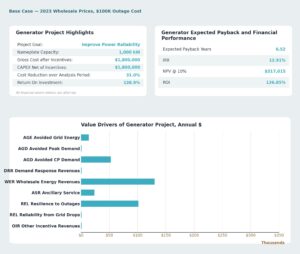
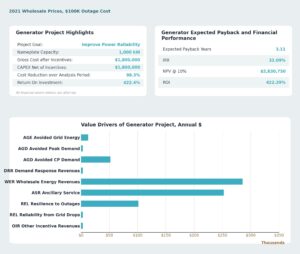
The single largest driver of difference between the base case (Project 1) and the two 2021-price scenarios (Projects 2 and 3) is the wholesale energy and ancillary services pricing environment. Project 1, built on 2023 ERCOT price data, produces a wholesale energy revenue contribution of roughly $135,000 annually and an ancillary services contribution in a comparatively narrow band. Projects 2 and 3, which substitute 2021 pricing for the same 1,000 kW asset, see wholesale energy revenue jump to roughly $300,000 annually, more than double, while ancillary services revenue rises to approximately $260,000, several times larger than in the base case.
This gap is not a modeling artifact; it reflects genuine market history. 2021 was an extraordinary year for ERCOT pricing, anchored by the multi-day price spikes to the system-wide offer cap during Winter Storm Uri, alongside elevated ancillary services clearing prices as the grid operator scrambled to procure reserves during a supply crisis. 2023, by contrast, was a more typical year, still volatile by other markets’ standards, but without a multi-day excursion to the price cap. The practical lesson for any developer or asset owner evaluating a reliability generator is that project economics in ERCOT are unusually exposed to the assumptions baked into the wholesale price curve used for the analysis.
This is precisely the variable the next iteration of this comparison will refine. Once updated average wholesale energy and ancillary services price assumptions are incorporated, the underlying revenue stack for each scenario can be recalculated with greater precision, and the resulting payback, IRR, NPV, and ROI figures adjusted accordingly. The structural takeaway, however, will hold regardless of the specific price inputs used: small changes in assumed average energy and ancillary prices produce outsized swings in project returns, because these two categories represent the majority of total project value in every scenario examined.
The financial performance metrics make the sensitivity concrete. Project 1, built on 2023 prices, returns a payback period of 6.52 years, an IRR of 12.91%, an NPV at a 10% discount rate of $317,015, and an ROI of 136.85%. Project 2, identical in every respect except substituting 2021 prices, returns a payback period of 3.11 years, an IRR of 32.09%, an NPV of $2,830,750, and an ROI of 422.39%. That is roughly a nine-fold increase in NPV and more than triple the ROI, driven entirely by the pricing environment assumed, with capital cost, nameplate capacity, and project goal held constant at $1.8 million, 1,000 kW, and improved power reliability, respectively.
The Assigned Value of Reliability Is Critical for These Projects
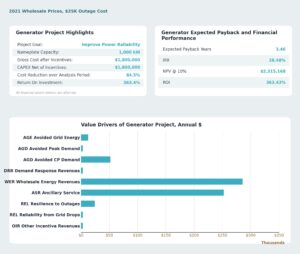
The comparison between Project 2 and Project 3 isolates a different, and equally important, variable: how much value is assigned to avoiding an extended outage. Both projects use identical 2021 wholesale energy and ancillary services pricing, and both retain the same $1.8 million capital cost and 1,000 kW capacity. The only change between them is the assumed annual cost of one extended power outage, reduced from $100,000 in Project 2 to $25,000 in Project 3.
That single assumption shift moves the resilience-to-outages value driver from roughly $110,000 annually in Project 2 down to approximately $30,000 in Project 3, and the downstream effect on financial performance is significant. Payback stretches modestly from 3.11 to 3.46 years, IRR falls from 32.09% to 28.48%, NPV declines from $2,830,750 to $2,315,168, and ROI drops from 422.39% to 363.43%. The cost reduction achieved over the analysis period also falls sharply, from 98.3% in Project 2 to 84.5% in Project 3.
This matters because the value of reliability is, by its nature, one of the harder inputs to pin down with precision. Unlike wholesale energy prices, which can be benchmarked against historical ERCOT settlement data, the cost of an outage is specific to each facility, a function of what is being produced, how perishable the output is, whether backup processes exist, and how exposed the operation is to safety or compliance consequences during a loss of power. Two facilities with identical generators and identical market exposure can have dramatically different project economics simply because one assigns a $25,000 cost to an outage and the other assigns $100,000. Getting this number right, through a defensible analysis of historical outage frequency and facility-specific impact, is therefore just as important to underwriting these projects accurately as getting the wholesale price assumptions right.
Summary and How DECH Can Help
Taken together, these three scenarios demonstrate that reliability generator economics in ERCOT hinge on two distinct categories of assumption: the market price environment for wholesale energy and ancillary services, and the facility-specific value of reliability itself. Holding capital cost and capacity constant, shifting only the price year took NPV from roughly $317,000 to over $2.8 million. Holding the price year constant and shifting only the outage cost assumption moved NPV by over half a million dollars and ROI by nearly sixty percentage points. Neither variable can be treated as a rounding error in a serious feasibility analysis.
This is where DECH adds value. Evaluating a reliability generator project requires more than a single-point estimate, it requires understanding the market rules and the energy price environment to enable a stress-testing of the prospective investment across realistic price environments and reliability scenarios so that decision-makers understand the full range of outcomes, not just a best case. The DECH self-service analytics application allows commercial and industrial customers across ERCOT to build defensible, scenario-based value stack analyses, incorporating site-specific outage history, current and historical wholesale and ancillary services pricing, and the full range of avoided-cost and incentive revenue streams available to behind-the-meter generation. Whether the goal is securing financing, validating a vendor’s proposal, or simply understanding how sensitive a project’s returns are to assumptions outside any one party’s control, the DECH analytics platform provides solid and defensible answers.