
Energy costs are one of the largest and least controllable line items for most commercial and industrial business owners. Utility rates have increased substantially in most U.S. markets over the past decade, and that is very likely to continue or even accelerate. Distributed energy projects can offer a proven path to lower costs and contain those costs over the long term.
A well-conceived DER project reduces what a facility buys from the grid, earns revenue by participating in demand management and energy market programs, and captures incentives that improve the overall return. In the Massachusetts market analyzed here, the relevant value stack includes avoided grid energy costs, avoided coincident peak demand charges, demand response program revenues, wholesale energy market participation, and applicable incentive programs. Together, these drivers can substantially improve a facility’s energy cost position and generate returns that compete with other capital investments.
Projects are sized to optimize capital efficiency within that local value stack, not simply to maximize system size. That means the configuration, capacity, and operation of a DER investment are all calibrated to the specific economics of the site, its load profile, and the programs available in its utility territory. Once that analysis is done, a very practical question arises: how does this capital compete with other business needs? For a commercial or industrial business owner, the distributed energy decision is rarely a clean choice between good and bad. It is usually a choice between competing uses of scarce capital.
That distinction matters. A business owner may have several attractive projects competing for funding: production equipment, building upgrades, warehouse automation, HVAC replacement, fleet electrification, working capital, or expansion into a new facility. A behind-the-meter DER project has to earn its place in that queue.
This value analysis for a Massachusetts facility compares two configurations: a standalone battery and a solar-plus-battery system. Both are sized to participate in the local distributed energy value stack. The primary conclusion is clear: the solar-plus-battery system produces the stronger financial result. But the more useful conclusion for business owners is more subtle.
How the Solar & Battery Numbers Stack Up
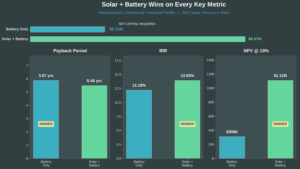
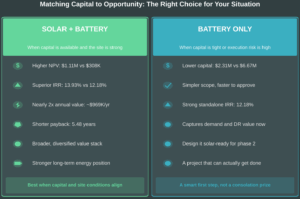
The solar-plus-battery project wins on every major financial metric. It delivers a shorter payback (5.5 vs. 5.9 years), a higher IRR (13.93% vs. 12.18%), and an NPV of $1.11M versus $308k for the battery-only case. Crucially, it also generates more NPV per dollar deployed: approximately $167 per $1,000 of capital, compared with $134 for the battery-only option.
That capital efficiency point is important. The larger project is not merely buying more value by spending more money. It is genuinely using each dollar more productively in this modeled scenario. A conventional project comparison asks: which option has the better payback, IRR, and NPV? A better owner-level question is “which option creates the best risk-adjusted use of scarce capital?”
Where the Value Is Actually Derived
This chart reveals why solar-plus-battery wins. The largest single change is avoided grid energy. The standalone battery carries a slightly negative avoided energy value because the battery must charge from the grid. The solar-plus-battery system, by contrast, creates approximately $331,000 in annual energy savings by offsetting utility purchases with onsite generation and can charge the battery.
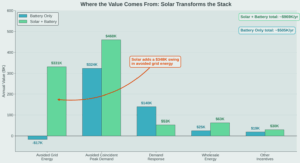
Solar also increases avoided coincident peak demand value (from $324k to $460k) and wholesale energy value (from $25k to $63k). Those gains, combined with the avoided energy benefit, more than offset the higher demand response revenue in the battery-only case ($140k vs. $53k). The investment insight is that solar-plus-battery wins because it broadens the value stack around a large, on-bill energy savings foundation.
More Value Potential Does Not Mean Less Risk
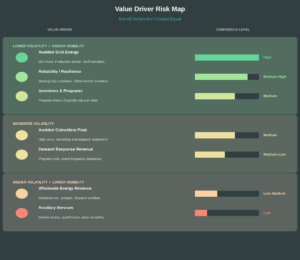
Risk should be evaluated by value driver. Avoided grid energy is low risk because it is anchored in onsite generation and retail bill reduction. Avoided coincident peak demand is a moderate risk because it depends on dispatch timing during narrow peak intervals. Demand response is also a moderate risk because revenues depend on rules, event frequency, and performance. Wholesale energy is a higher risk because market prices and dispatch opportunities are volatile. Other incentives, which in our model include Clean Peak benefits, are a moderate risk because qualification, compliance, timing, and program availability can affect realized value.
Matching Capital to Opportunity
Capital should follow the dependability of the value stack, not just the modeled return. A larger solar-plus-battery case is stronger when core savings are durable and market-facing revenues are managed effectively. A battery-only solution may be preferable when value realization confidence is lower or program revenue is less certain over time. Developers and investors in distributed energy projects are keen to understand these value drivers and the extent to which they can rely on these value streams over a lengthy project life.
Realizing the DER Value Stack: The Role of a Market Intermediary
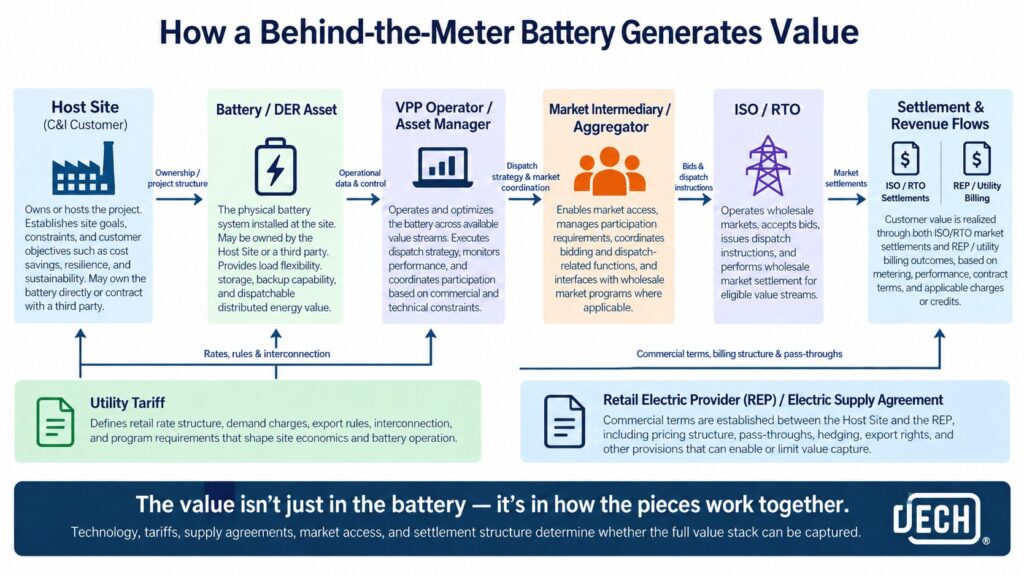
A compelling value stack on paper is only the beginning. For the business owner, turning this estimated value into realized financial impact requires navigating a layer of market complexity that practically all businesses are not able to manage on their own. Program enrollment, dispatch optimization, wholesale market participation, demand response event management, incentive qualification, and ongoing performance monitoring all require specialized expertise, technology platforms, and market relationships. The core business is not energy trading or utility program administration.
This is where a market intermediary plays a necessary role. A qualified intermediary provides the operational infrastructure that connects the physical distributed energy assets to the full range of programs and facilitates value-realization in the energy markets. That includes automated dispatch platforms that co-optimize across competing value streams in real time, direct program enrollment and compliance management with the relevant utilities and grid operators, wholesale market access and bidding strategy, performance reporting that gives the owner visibility into realized versus modeled value, and ongoing advisory as programs, rates, and market conditions evolve.
For business owners working with third-party project developers or equipment providers, the intermediary relationship should be defined as a critical part of project conceptualization. Who controls dispatch? How are competing value streams prioritized? What happens if a program changes? These questions have real financial consequences and should be addressed in the project agreement.
The Bottom Line
The value analysis points to solar-plus-battery as the superior financial case. It produces stronger payback, IRR, NPV, ROI, and capital efficiency. It also creates a broader value stack, anchored by a substantial avoided energy benefit the standalone battery cannot capture.
But the best financial model is not always the best capital decision. A business owner facing scarce capital must ask whether the larger investment displaces better uses of funds, whether the value-stack components are dependable enough to justify the commitment, and whether a market intermediary or project partner is in place to realize the projected returns.
The lesson is not that the largest project always wins. The lesson is that the best distributed energy decision comes from matching capital availability to value-stack quality, and then ensuring the operational infrastructure exists to capture that value once the equipment is in the ground.