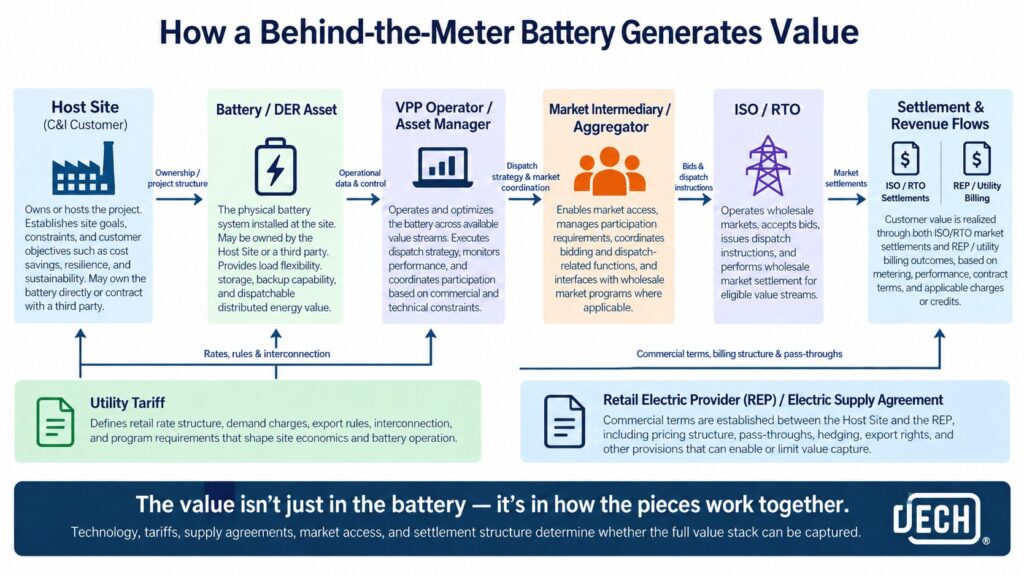

A battery does not create value simply by storing electricity. It creates value by giving a business control over when it buys power, when it uses power, when it reduces demand, and when it makes capacity available to the grid. That distinction matters more than ever. Battery economics were once commonly explained through arbitrage: charge when electricity is cheap, discharge when it is expensive, and capture the spread. California’s duck curve made the concept especially compelling.
But as battery deployment has grown, batteries have begun flattening the price spreads they were built to capture. Arbitrage remains valuable in some markets and during volatile periods, but for many behind-the-meter projects, the strongest business case now comes from a broader value stack.
Across the United States, four flexibility value drivers are likely to matter most.
1. Controlling the Customer’s Electric Bill
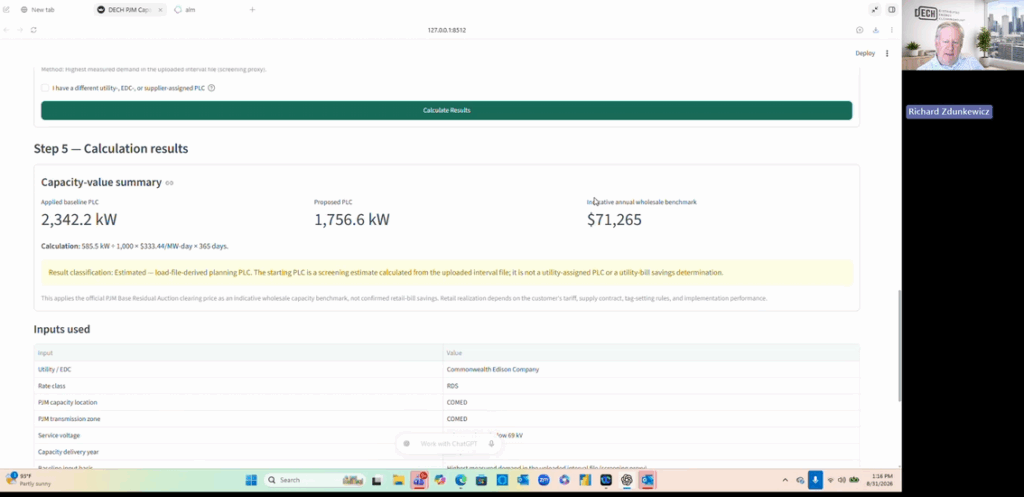
The first place to look for battery value is usually the customer’s utility bill, not the wholesale market. Commercial electric bills may include time-of-use energy charges, monthly demand charges, coincident peak charges, transmission-related charges, and low compensation for excess solar exports.
A battery can respond differently to each. It can charge during low-cost hours and discharge during expensive retail periods. It can prevent a brief facility peak from setting a high monthly demand charge. It can reduce load during the handful of system peak hours that determine annual capacity or transmission costs. For solar customers, a battery can store midday generation that would otherwise be exported at a low rate and use it later to avoid a more expensive retail purchase.
These opportunities may be more durable than wholesale arbitrage because they are tied to the customer’s tariff and operating profile. But they are also site-specific. The tariff, interval load, solar production, battery size, and operating limits all affect the result.
2. Getting Paid to Support the Grid
The second major source of value is compensation for making battery flexibility available when the grid needs it. Depending on the market and utility territory, a battery may participate in demand response, capacity or resource adequacy programs, ancillary services, utility peak-reduction programs, virtual power plants, or other performance-based programs.
These arrangements may pay the customer for committing capacity, remaining available during designated hours, responding to dispatch instructions, or delivering measurable performance during grid events. For many behind-the-meter batteries, these payments can be more valuable and predictable than routinely chasing wholesale energy prices.
The complication is commitment. A battery promised to a grid program may need to preserve state of charge or reserve discharge capacity. It may be unavailable for another purpose during the same hour. Program revenue therefore cannot simply be added to every other value stream without checking whether the operating requirements overlap.
3. Capturing Incentives and Performance Payments
The third layer comes from public policy. Federal tax incentives, depreciation benefits, state grants, utility rebates, and performance-based clean-energy programs can materially improve project economics.
Some incentives reduce the initial cost of installing the battery. Others reward specific behavior, such as discharging during designated peak periods, supporting critical facilities, or pairing storage with renewable generation.
Because many of these benefits are established by law or program rules, they may be more predictable than hourly market revenue. But the advertised amount is not always the amount a project can realize. Eligibility may depend on location, ownership, charging source, operating hours, minimum performance, construction requirements, and interaction with other grants or tax benefits.
Incentives can be one of the more financeable parts of the value stack, but only when eligibility and compliance are clearly understood.
4. Protecting Operations During an Outage
Resilience is different from the first three drivers. Bill savings and grid programs produce recurring returns. Resilience protects the business from a loss that may occur infrequently but could be severe. A properly configured battery can keep selected loads operating during an outage, particularly when paired with solar, transfer equipment, controls, or a microgrid.
Its value may include avoiding production losses, spoiled inventory, interrupted communications, emergency relocation, equipment restart costs, lost sales, and health or safety consequences.
But resilience is not free. A battery cannot provide several hours of backup power if it has already discharged to capture an afternoon price spread. Maintaining resilience may require reserving a minimum state of charge, reducing the capacity available for other uses. For some customers, resilience will be the primary reason to install a battery. For others, it will be an important secondary benefit. Either way, it should be modeled explicitly rather than treated as a vague bonus.
The Real Value Is in the Coordination
The modern battery value stack is not a list of revenues that can automatically be added together. A system peak may occur during a demand-response event. A battery reserved for an evening grid program may not also be available to reduce a facility’s peak demand. Aggressive cycling may increase degradation. A resilience reserve may limit market participation. One program may restrict participation in another.
The central question is therefore no longer “How much can this battery earn from arbitrage?” It is “Which uses of flexibility create the greatest value for this customer, in this market, without double-counting the same battery capacity?” The best projects establish priorities and coordinate dispatch around the battery’s physical limits, the customer’s operations, and the rules of each applicable program.
The battery is the hardware. The real asset is the ability to direct its flexibility toward the right value at the right time.