
Explore how data analytics in renewable energy and renewable project data analysis optimize DER dispatch, maximize lifecycle value, and unlock asset optionality.
Data Analytics in Renewable Energy
The intrinsic value of Distributed Energy Resources (DERs) has undergone a profound transformation. What began as a resilience strategy or sustainability initiative has evolved into something far more complex and financially significant. Solar arrays, battery energy storage systems, and clean-burning distributed generators are no longer simply engineering assets installed to reduce outages or meet environmental targets. They have become dynamic financial instruments whose value depends not only on how well they operate, but on how intelligently they are managed.
The shift has been driven by structural changes in grid markets, rapid advancements in battery efficiency, improvements in optimization software, and the growing volatility introduced by intermittent renewable generation and extreme weather events. In this new environment, extracting value from distributed energy systems requires more than maintenance excellence. It requires advanced data analytics in renewable energy, supported by rigorous and continuous renewable project data analysis.
Organizations that understand this shift are beginning to manage DER portfolios the way financial institutions manage trading books — balancing optionality, risk, timing, and lifecycle considerations. Those that do not risk underperforming in increasingly competitive and volatile markets.
The Structural Shift: From Reliability to Revenue Optimization
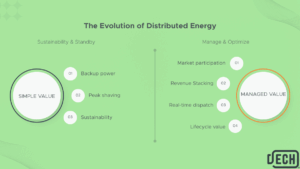
For many years, DER management focused on a relatively narrow set of objectives. Operators prioritized uptime, system availability, and state of charge. A battery’s primary role was peak shaving. A generator existed for backup reliability. Solar generation reduced net load and provided environmental benefits. The core operational question was straightforward: Is the asset functioning properly and ready if needed?
Today, that mindset is insufficient.
Independent System Operators (ISOs) have expanded their grid-support products, offering compensation for flexibility and responsiveness. Programs such as ERCOT’s DRS Ancillary Services illustrate how distributed assets can participate in markets that reward fast response and capacity availability. Meanwhile, improvements in battery chemistry and control systems have reduced response times and increased dispatch precision. Optimization platforms now process real-time data streams that were unavailable just a decade ago.
Simultaneously, the rapid growth of intermittent renewable generation has introduced volatility into wholesale markets. Price spikes and negative pricing events occur with increasing frequency. Extreme weather events have exposed vulnerabilities in centralized systems, elevating the strategic importance of flexible distributed capacity.
These forces have combined to fundamentally change the objective of DER management. The central question is no longer whether the asset is operational. It is whether the asset is being dispatched at the optimal moment to maximize economic value while preserving long-term performance. This transformation marks the rise of data analytics in renewable energy as a core strategic capability rather than a reporting function.
The Convergence of Physical and Market Intelligence
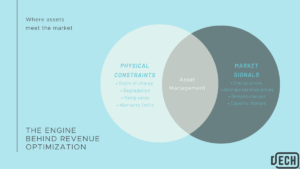
At its core, DER optimization requires reconciling two separate worlds: physics and markets. On one side lies the physical reality of the asset. Batteries operate within defined state-of-charge windows. They degrade with cycling intensity and thermal stress. Generators have ramp rates, minimum run times, and fuel constraints. Solar inverters operate within voltage and export limits. Maintenance schedules and warranty provisions impose additional restrictions. These constraints define what is physically possible.
On the other side lies the market environment. Real-time pricing fluctuates hourly or even sub-hourly. Demand charges depend on interval peaks. Capacity payments require availability during defined windows. Ancillary services demand rapid response. Carbon credit values shift with regulatory changes. These signals define what is economically desirable.
Optimization occurs only when these two domains are integrated in real time. A battery may be technically capable of discharging, but if the discharge occurs before a price spike, its optionality is diminished. A generator may be physically ready, but dispatching during low-price intervals erodes fuel economics. The complexity arises because these variables are not static. Physical conditions change as assets degrade or weather shifts. Market signals evolve with congestion, renewable output, and demand fluctuations. Only disciplined and continuous renewable project data analysis can reconcile these moving parts.
Digitization has made this integration possible. Modern telemetry systems, cloud-based SCADA platforms, and API-driven market data feeds allow operators to monitor both domains simultaneously. However, access to data is not the same as extracting value from it. Without advanced analytical frameworks, the abundance of information becomes noise rather than insight.
Optionality: The Hidden Financial Engine Within DERs
The defining feature of distributed energy assets is optionality. A battery does not simply store energy; it stores decisions. Every hour presents multiple possible actions — charge, discharge, or remain idle. Each action carries implications not only for immediate revenue but for future flexibility.
This embedded optionality is analogous to a financial derivative. Its value depends on volatility, timing, and constraints. In stable markets with flat pricing, the economic spread between charging and discharging narrows. In volatile markets, the value of flexibility expands dramatically.
Investors increasingly recognize this dynamic. Capital is flowing toward platforms and operators capable of matching DER asset optionality with reliable physical supply. Batteries deployed at scale, especially when paired with generation assets, provide suppliers with risk mitigation tools and alternatives to capacity charges. Their ability to respond dynamically to market signals makes them economically attractive far beyond their traditional resilience role.
However, optionality only translates into realized value when it is actively managed. Mis-timed dispatch can permanently eliminate opportunity. Discharging too early may prevent participation in higher-priced intervals later. Over-committing to one revenue stream may limit access to others.
Advanced data analytics in renewable energy platforms quantify this optionality, measuring both realized revenue and unrealized opportunity cost. They help operators evaluate trade-offs among stacked revenue streams, determine optimal state-of-charge positioning, and anticipate future value windows. Without this analytical rigor, optionality remains theoretical rather than financial.
Optimization Within Guardrails: Balancing Revenue and Longevity
While optionality expands opportunity, physical constraints impose discipline. Batteries degrade with cycling intensity. Excessive depth of discharge accelerates capacity loss. Generators incur maintenance costs based on runtime and load factors. Interconnection agreements limit export volumes. Warranty provisions restrict operating envelopes. The tension between short-term revenue maximization and long-term asset health is central to DER economics. For example, aggressive daily cycling may increase arbitrage revenue in the near term, but it may also reduce the battery’s usable life, increasing replacement costs and eroding total return on investment. Similarly, dispatching a generator during marginal price events may create fuel inefficiencies that outweigh revenue gains.
True optimization therefore requires lifecycle-aware decision-making. Sophisticated renewable project data analysis incorporates degradation modeling, cost-of-capital assumptions, warranty limitations, and risk scenarios into dispatch algorithms. Rather than maximizing interval revenue, these systems maximize lifecycle-adjusted value.
Traders and portfolio managers must understand these guardrails. Engineering teams must communicate operational constraints clearly. Financial teams must integrate degradation costs into revenue models. Only through cross-disciplinary integration can DER portfolios achieve durable performance.
Forecasting as the Core Value Driver
In increasingly volatile energy markets, predictive capability determines competitive advantage. Reactive dispatch strategies — such as simple price-threshold rules — are insufficient when market dynamics are shaped by weather patterns, renewable intermittency, congestion events, and regulatory changes. Price spikes often occur with little warning unless sophisticated forecasting models detect underlying signals.
Advanced forecasting systems analyze weather-adjusted load projections, forward pricing curves, historical volatility distributions, and probability-weighted scenarios. Machine learning algorithms refine price predictions by identifying nonlinear relationships and anomaly patterns. Scenario modeling evaluates multiple possible futures before committing to a dispatch strategy. This is where data analytics in renewable energy transitions from descriptive analysis to prescriptive optimization. Rather than asking what happened yesterday, operators focus on what is likely to happen tomorrow — and how to position assets accordingly.
Forecast accuracy directly influences profitability. A one-hour timing improvement in discharge during peak pricing can materially affect annual revenue. As markets become more dynamic, predictive analytics become indispensable.
Building the Integrated Optimization Architecture
Achieving this level of sophistication requires more than individual analytics tools. It demands an integrated technological architecture that connects physical telemetry, market data feeds, tariff engines, and optimization algorithms into a unified platform.
Real-time data ingestion ensures that dispatch decisions reflect current state-of-charge, thermal conditions, and operational constraints. Market API integrations provide continuous updates on pricing and ancillary service signals. Tariff modeling engines simulate demand charge impacts under various scenarios. Historical performance databases enable back-testing and performance benchmarking. Degradation models simulate long-term asset impact. Cybersecurity and auditability are essential components of this architecture, particularly as DER portfolios grow and regulatory scrutiny increases.
Data silos undermine optionality. If market analysts operate independently from engineering teams, dispatch decisions become fragmented. If tariff updates lag regulatory changes, revenue projections become unreliable. Integration ensures that every decision reflects a complete understanding of both physical and financial realities. Scalable renewable project data analysis platforms enable portfolio-level insights, allowing operators to compare geographic regions, allocate capital more efficiently, and identify emerging value hotspots. As portfolios expand, centralized optimization engines coordinate dispatch across multiple sites, capturing synergies and mitigating risk.
Measuring Value in a Portfolio Context
As DER management evolves, so too must performance measurement. Traditional metrics such as uptime and capacity factor provide limited insight into financial optimization. A battery may achieve near-perfect availability yet still underperform financially if dispatch timing is suboptimal. More sophisticated evaluation frameworks examine realized value relative to theoretical potential, capture rates of price volatility, revenue per cycle, and degradation-adjusted returns. Sensitivity analysis assesses how portfolio performance would shift under alternative tariff structures or regulatory changes.
These measurements require integrated data analytics in renewable energy capabilities capable of reconciling engineering performance with financial metrics. At the executive level, the conversation shifts from equipment performance to portfolio performance. Leaders must ask whether distributed assets are being operated conservatively or managed dynamically as financial instruments. This perspective enables stronger capital allocation decisions and more disciplined underwriting of future investments.
From Operational Excellence to Strategic Differentiation
Organizations that master integrated optimization gain advantages that extend beyond immediate revenue capture. Lower effective energy costs improve competitiveness. Reduced exposure to price volatility enhances financial stability. Enhanced resilience economics strengthen operational continuity. Stronger analytics capabilities attract investor confidence.
Looking ahead, the competitive landscape will increasingly favor organizations capable of granular, location-specific valuation modeling. Geographic heat maps of distributed energy value will inform site selection and expansion strategies. Automated dispatch systems will coordinate portfolios at scale. Integration with procurement and hedging strategies will blur the line between energy operations and financial risk management. In this environment, renewable project data analysis becomes a strategic asset. It informs not only operational decisions but long-term planning and capital deployment.
Optimization is no longer an operational refinement. It is a defining competency.
Conclusion: Data as the Control System for Value
Distributed energy assets are dynamic systems operating within volatile markets and constrained by physical realities. Extracting their full economic potential requires more than technical proficiency. It requires integrated forecasting, lifecycle modeling, market intelligence, and cross-disciplinary collaboration.
Advanced data analytics in renewable energy provides the foundation for this transformation. Rigorous renewable project data analysis converts raw data into actionable insight, aligning dispatch decisions with both immediate opportunity and long-term asset health. As grid complexity increases and renewable penetration accelerates, the organizations that treat data as their primary control system for value will lead. Those that rely on static rules or fragmented analysis will struggle to keep pace.
The future of distributed energy is not defined solely by hardware innovation. It is defined by the intelligence applied to its operation. And in that future, data is not supportive infrastructure. It is the engine of financial performance.