Which energy investmentfits your facility?
Solar, batteries, generators, and hybrid systems solve different problems. Compare potential value before committing to a technology.
For early-stage project qualification. Not a final engineering study or investment recommendation.
The best technology is the one that solves the facility’s investment question. Solar, storage, on-site generation and hybrid systems have different operating strengths, cost profiles and reliability requirements.
Three assets. Different economics. Different tradeoffs.
Start by understanding what each technology can contribute to your facility’s objectives.
Solar
Use on-site generation to offset eligible electricity consumption and support emissions goals.
Battery storage
Shift electricity use, manage peaks, and explore eligible market programs.
Generators
Evaluate on-site power, reliability, and potential demand-management use cases.
Compare alternatives against your actual priorities
These are illustrative qualitative comparisons, not a substitute for site-specific modeling.
| What you care about | Solar | Battery storage | Generator | Solar + battery |
|---|---|---|---|---|
| Offset purchased energy | Strong fit | Depends | Depends | Strong fit |
| Manage short-duration demand peaks | Depends | Often relevant | Depends | Often relevant |
| Provide backup power | Not alone | Design-dependent | Often relevant | Design-dependent |
| Reduce emissions | Often relevant | Dispatch-dependent | Fuel-dependent | Often relevant |
| Participate in market programs | Eligibility varies | Eligibility varies | Eligibility varies | Eligibility varies |
Four questions that change the answer
An equipment-first comparison misses the most important constraints. Before choosing solar, batteries, generators or a hybrid, establish what the facility is trying to accomplish and how success will be measured.
Reduce energy spend
Are you primarily reducing grid kWh purchases, time-of-use purchases, the monthly demand peak, or all three? Solar and storage affect different components.
Maintain operations
What loads must remain powered in an outage, and for how long? Is seamless transfer required? Reliability value depends on actual system architecture.
Earn grid revenue
Which dispatch, demand-response and market programs are available? Participation may depend on market rules, metering, resource characteristics and contracts.
Meet carbon goals
How will the technology affect net emissions after accounting for fuel, displaced grid energy, charging source and operating schedule?
A high-quality comparison also accounts for available space, rooftop or land conditions, interconnection feasibility, capital budget, operating complexity, and the ability to stage investment over time.
The facility profile changes which option deserves screening
These situations are illustrative, not recommendations for an actual address. Their purpose is to show how a site’s operating and tariff conditions can change the starting point.
Daytime-heavy warehouse
A large roof and steady daytime consumption may support a solar-first assessment. Add storage screening if demand spikes, low export compensation or evening demand materially change the value proposition.
Factory with sharp peaks
Large, short-duration equipment starts may merit load management and battery peak-shaving analysis. A generator is not automatically the cheapest or most practical peak-reduction tool.
Reliability-critical site
A data center or critical manufacturer may prioritize backup duration, fuel logistics and transfer capability. A battery, generator or hybrid microgrid must be evaluated against specific critical loads.
See a real DECH technology comparison
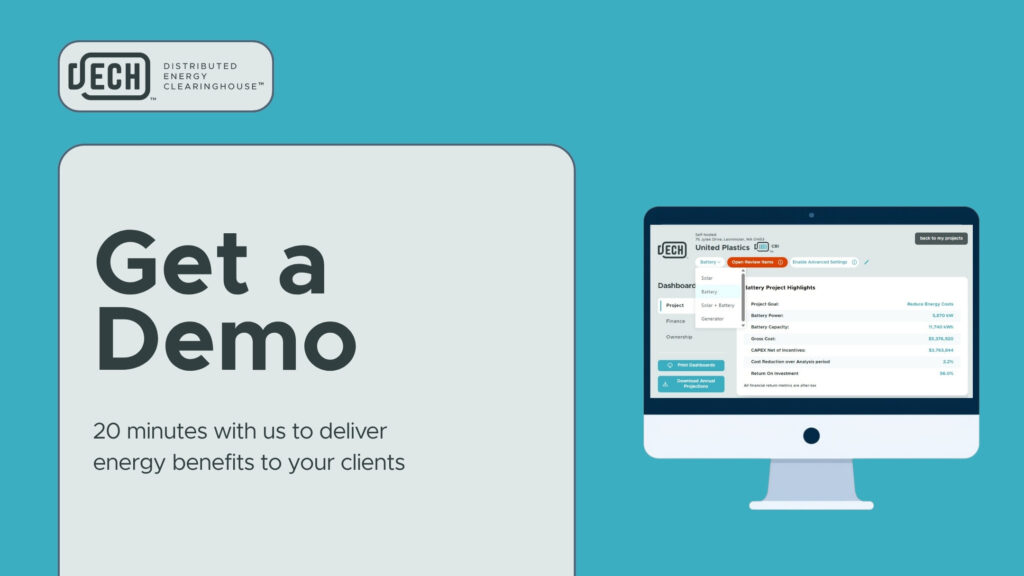
DECH evaluated solar, storage, generation and high-level microgrid alternatives for a planned industrial facility in West Texas.
What matters most at this facility?
Choose an objective to explore the questions that change the comparison. This guide does not select equipment for a real site.
Start with the charges you can actually change.
Ask whether the priority is reducing purchased energy, avoiding selected demand peaks or shifting electricity purchases between time periods. Keep the same site inputs when comparing technologies.
Solar
Screen where production overlaps valuable load and where site area, export terms and installed cost support the case.
Battery
Test the timing and duration of peaks, time-of-use exposure, recharge needs and any competing commitments.
Generator
Confirm lawful operating uses and account for fuel, service, emissions requirements and run-hour limitations.
Define the outage requirement before sizing equipment.
List critical circuits, startup loads, required transfer time and the outage duration the site must withstand. Reliability comes from the complete system design, not the equipment name alone.
Solar + storage
Assess islanding controls, usable energy, solar variability and recovery during an extended outage.
Generator
Review fuel availability, starting reliability, transfer equipment, maintenance and permitted use.
Hybrid
Test how batteries, generation and controls share critical loads. Integration adds both capability and cost.
Compare emissions on a consistent basis.
Solar production, battery charging and engine operation affect emissions differently. A financial benefit does not by itself establish a carbon benefit.
Solar generation
Evaluate production and the grid electricity it displaces. Keep the accounting boundary clear.
Storage dispatch
Account for charging source, charging time, discharging time and round-trip losses.
On-site generation
Consider fuel, efficiency, run hours, local air requirements and the alternative source of electricity.
Compare technology options on the same basis
A fair comparison uses the same site load, tariff, investment horizon and financial assumptions, rather than comparing vendor-generated numbers that each use different inputs.
- Establish common site inputs Use the same annual consumption, interval load, utility rate, tax and financing assumptions where appropriate.
- Design realistic configurations Define solar size, battery kW/kWh, generation capacity, backup needs and physical constraints for each option.
- Analyze the full but realizable value Consider bill avoidance, relevant market revenue, incentives, resilience and carbon, without assuming all opportunities can be captured at once.
- Stress-test the result Compare base, conservative and upside assumptions. Identify whether one attractive forecast depends on a single uncertain source of revenue.
Four different investment paths
This is a qualitative screening guide. Actual technical and economic outcomes require modeling.
The cheapest equipment quote is not always the lowest-cost solution
The investment case should weigh useful energy, usable capacity, dispatch controls, reliability performance, project costs and implementation risks over time.
Grid-tied PV normally requires appropriate inverters, islanding capability and other equipment to serve loads when the grid fails.
A 1 MW battery’s duration depends on its usable energy capacity, state of charge and discharge constraints. Power rating alone says little about backup hours.
Fuel availability, operating permits, emissions, noise, maintenance, starting characteristics and utility interconnection can shape the business case.
Combining solar and storage can create new value but also adds controls, capital costs and competing dispatch priorities.
Reference: EPA stationary-engine regulations and compliance resources.
Questions buyers ask before taking the next step
Actual economics, operating constraints and program eligibility require site-level review.
Is battery storage better than solar for reducing demand charges?
Not categorically. Storage can be dispatched at selected peaks, while solar output follows available sunlight. Either may reduce a particular billed peak depending on load timing and rate structure. Compare them using the same interval data.
Can a generator make money when there is no outage?
In some settings, on-site generation may reduce eligible peak charges or participate in approved grid programs. Operating permits, emissions limits, fuel costs and program restrictions are critical.
Does a solar-plus-storage system always produce better ROI than solar alone?
No. Added storage can create demand, timing, resilience and program value, but it also adds cost. The combined financial benefit must exceed incremental ownership and operating expenses.
What is the next step after a preliminary technology comparison?
Shortlist plausible configurations, then advance the strongest candidates to detailed engineering, utility/interconnection diligence and investment-grade commercial analysis when warranted.
Compare the options before committing to one.
Start with the facility objective. See how DECH can help screen the technologies and configurations worth investigating.