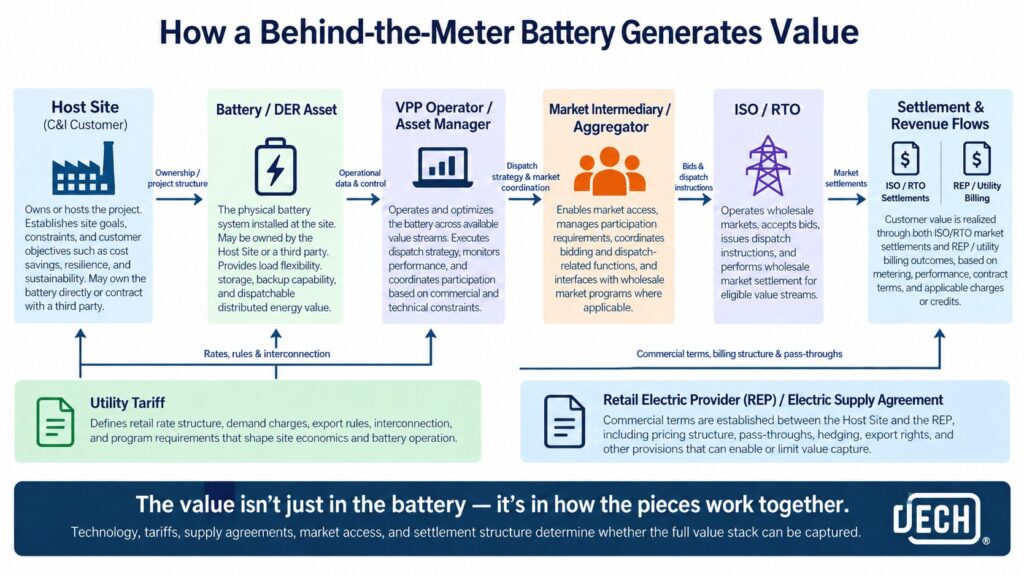

Virtual power plants promise flexibility, efficiency, and new value streams for distributed energy resources. But in practice, whether a VPP succeeds often has less to do with technology, and more to do with market rules.
Across the U.S., wholesale electricity markets are opening their doors to DER aggregation. Yet each region defines participation differently, with unique requirements that can either enable or block VPPs altogether.
Understanding these rules is critical.
The Reality of Market Participation
From the outside, VPP participation may seem straightforward: aggregate assets, meet minimum size thresholds, bid into markets. In reality, the process is far more nuanced.
Markets define:
- Minimum aggregation sizes
- Asset eligibility
- Telemetry and metering standards
- Performance penalties
- Dispatch and settlement mechanisms
A VPP that qualifies in one ISO/RTO may be completely ineligible in another, even with the same assets.
Rules Shape Technical Architecture
Market requirements directly influence how VPPs are designed. Telemetry latency, data granularity, and control capabilities must align with specific market expectations.
For example:
- Some markets require near-real-time telemetry
- Others allow aggregated or delayed reporting
- Certain products require direct dispatchability
These distinctions matter. They affect hardware selection, software architecture, operational workflows, and ultimately project economics.
Aggregation Isn’t Just About Scale
While aggregation increases scale, it also increases complexity. Assets may differ in size, ownership, and operational constraints. Aligning them under a single market participation model requires careful modeling and validation.
Market rules often determine how much flexibility an aggregator has, and how much risk they assume. Poor alignment between assets and market rules can lead to underperformance or penalties.
Why Market Knowledge Is a Competitive Advantage
As DER participation expands, market literacy is becoming a differentiator. Developers and asset owners who understand regional rules can structure projects more effectively from day one.
This includes:
- Choosing the right markets to target
- Designing assets to meet participation thresholds
- Avoiding costly retrofits or exclusions
The most successful VPPs are built with market rules in mind, not adapted after the fact.
A Practical Look at Markets and Aggregation
For a detailed, real-world look at how market rules enable or restrict VPP participation, we recommend PV Magazine’s article, “Virtual power plants in action: How rules and markets enable (or block) aggregation.”
It highlights the practical realities developers face when bringing aggregated DERs into wholesale markets.
As markets continue to evolve, clarity around rules and requirements will only become more important. Virtual power plants will play a growing role in grid operations, but only for those who can navigate the rules that govern them.