
New York Value Stack Methodology
How New York compensates distributed resources for electricity production and local grid value.
Energy
Capacity
Environment
Local Grid Value
New York introduced the Value Stack as a compensation scheme designed to value distributed energy resources according to when and where they provide electricity to the grid.
Compensation can take the form of payments to energy producers or bill credits for off-takers. The original methodology considered five components: energy, capacity, environmental value, demand reduction, and locational system relief.
Understanding the Value Stack
Electricity supplied or exported.
Value related to meeting system demand.
Recognized clean-energy attributes.
Potential value from reducing system demand.
Additional value where distributed resources alleviate local constraints.
Who Was Eligible Under the Historical Framework?
At the time of the original analysis, the methodology applied to certain nonresidential on-site installations larger than 750 kilowatts AC and remote-metered projects, including Community Distributed Generation (CDG) arrangements.
Covered installations above the specified capacity threshold.
Qualifying remote configurations, including community solar.
Monetary payments for energy producers or bill credits for eligible off-takers.
Development of New York Value Stack Capacity
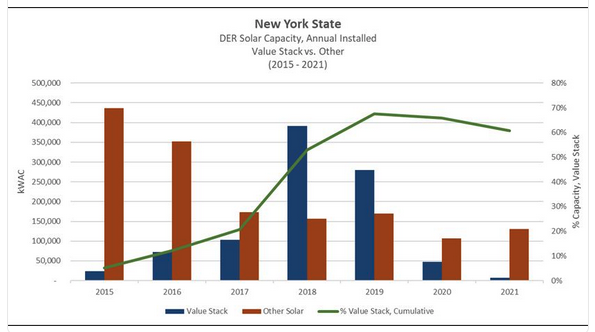
Value Stack capacity grew substantially during 2018 and 2019 as community solar projects advanced. Project completions dropped sharply in 2020 and 2021 as the market dealt with COVID-19 and supply-chain disruptions.
Project Backlog and Historical Outlook
With a backlog exceeding 2,000 MW as of January 2022, DECH expected additional Value Stack development later in 2022 and into 2023. That was the forward-looking view expressed in the original historical commentary.
Location, time of delivery, and grid impacts can materially change the economic value of a distributed energy project.
This is a historical review. Confirm current New York VDER eligibility, values, and compensation rules before making investment decisions.
Explore New York DER Economics
Evaluate site-specific energy costs, compensation opportunities, and distributed energy investment strategies.