
Behind-the-Meter Batteries: Know Where the Value Is Before You Invest
Behind-the-meter battery storage is drawing increasing interest from commercial and industrial electricity customers, and for good reason. The technology offers the potential to reduce electricity costs, generate additional revenues, and improve reliability, often from the same installation. But the economics are more complicated than they might first appear. What makes a battery an attractive investment at one location may have little relevance at another, even where electricity consumption and equipment costs are similar.
For businesses evaluating such investments, the fundamental question is not simply how much a battery will cost or how much electricity it can store. It is how that battery will create economic value over its operating life, how dependable that value will be, and what must happen for the owner to capture it.
The Complex Economics of Battery Storage
A commercial battery can produce value through a surprisingly wide range of mechanisms. Demand charge reductions are often an obvious starting point, particularly for facilities with pronounced peaks in electricity consumption. In some markets, managing coincident peaks can also reduce transmission or capacity-related charges. Batteries can shift electricity purchases between periods of high and low prices, participate in demand response programs, and provide services to wholesale electricity markets. Resilience benefits and investment incentives can further influence the economics.
These opportunities are often described collectively as the battery's "value stack," although the term can make the process sound more straightforward than it really is.
The individual benefits do not necessarily add together neatly. A battery committed to a wholesale market program may have less capacity available to reduce a customer's peak demand. Maintaining a reserve for backup power can limit opportunities to earn market revenues. Even the savings associated with energy arbitrage may depend as much on the terms of the electricity supply agreement as on the difference between hourly market prices.
The relative certainty of these benefits also varies. Some savings can be estimated with reasonable confidence from a customer's electricity usage and tariff structure. Other revenues depend on market volatility, program eligibility, dispatch frequency, and market rules that can change during the investment's life. A forecast that treats all of these opportunities as equally dependable, or assumes they can all be captured at once, can create a misleading picture of the investment.
This matters when deciding how much storage to install. A battery sized primarily to reduce demand charges may look quite different from one intended to pursue wholesale market opportunities. Storage duration, power capacity, operating limits, and even the customer's tolerance for battery cycling can influence the preferred configuration. The most economic answer often emerges from evaluating these considerations together, rather than treating each potential benefit independently.
Bringing Market Intelligence Into the Investment Process
The electricity industry has become increasingly sophisticated in optimizing battery operations. Market participants use detailed pricing data, market rules, customer load characteristics, and operating constraints to determine when storage capacity should be charged, discharged, or committed to grid services. Those same analytical considerations are essential when evaluating the investment in the first place.
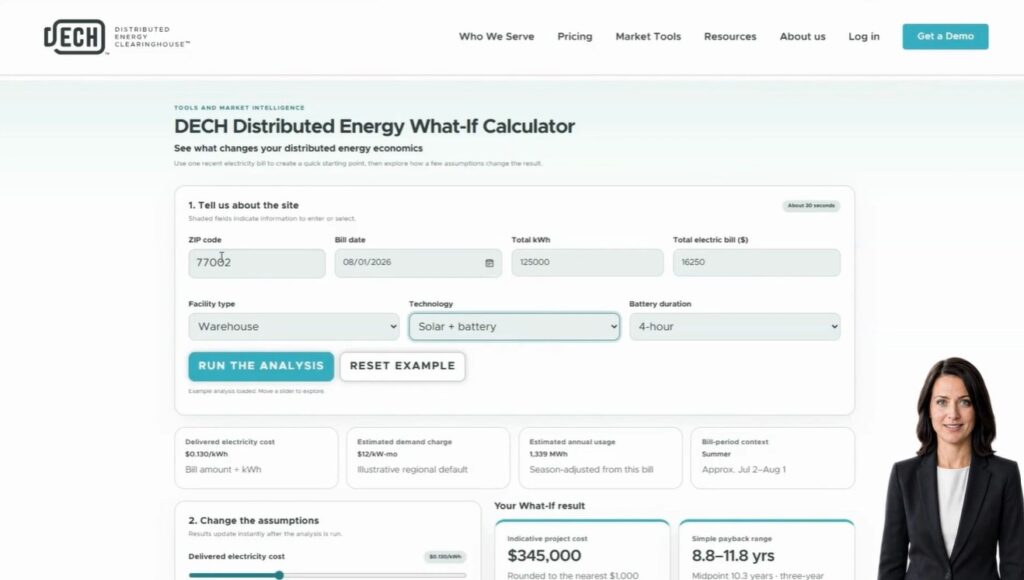
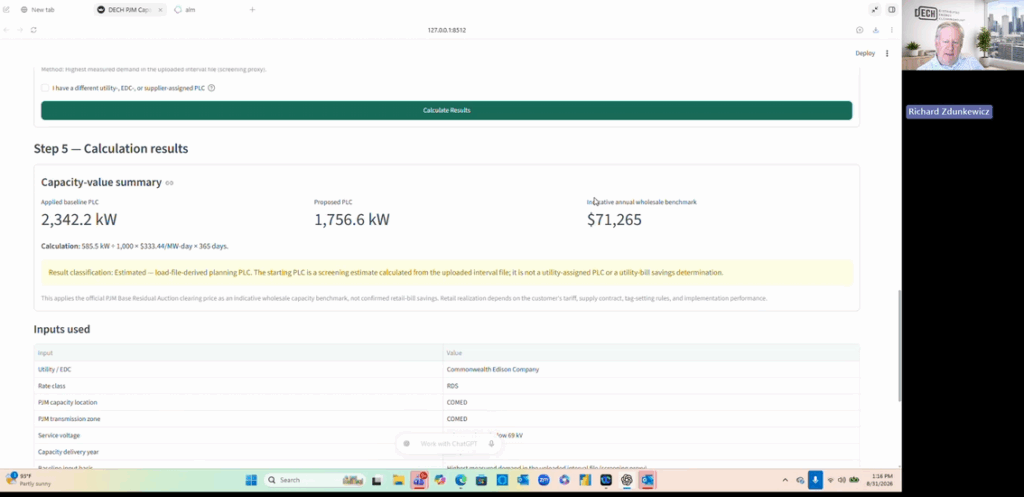
That is the approach taken by Distributed Energy Clearinghouse (DECH). Our software analytics platform, supported by our expertise in power markets and distributed energy economics, applies market data, tariff structures, market-design rules, and battery operating assumptions to evaluate the potential value of an installation before the investment is made.
Rather than relying on a single estimate of annual savings or market revenues, DECH examines the sources of value individually and in combination. The analysis considers how different opportunities interact, the uncertainties associated with each, and the operational implications of capturing them. It provides developers, investors, and host energy users with a more complete understanding of the economics supporting a proposed installation.
This is particularly important because the largest potential revenue stream is not always the most valuable one when viewed in the context of the entire project, market design and operational realities. A relatively dependable reduction in electricity costs may be worth more to an investor or customer than a larger but highly uncertain market revenue opportunity. Conversely, participation in certain market programs may materially improve the economics of an otherwise marginal investment. The appropriate balance depends on the location, the customer's operating requirements, and the risks the investor is prepared to accept.
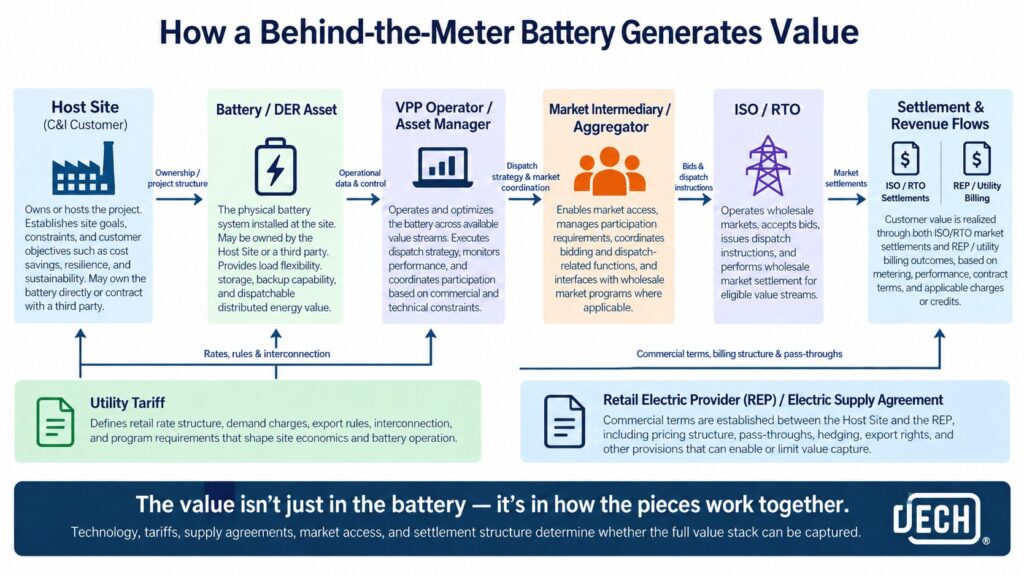
There is also a commercial dimension that deserves attention. The electricity supply agreement can materially affect the value of battery operation, particularly where demand charges, capacity costs, or exposure to wholesale electricity prices are involved. Likewise, agreements governing market participation establish dispatch rights, performance obligations, operating restrictions, and the division of revenues between the battery owner and the service provider. These arrangements should be considered while the investment is being evaluated, rather than negotiated independently after the equipment has been installed.
DECH's analytics provide the foundation for that coordination. Where customers request additional support, we help translate the investment analysis into a strategy and a plan consistent with the expected sources of value. The intent is to connect the assumptions used to justify the investment with the commercial terms and operating decisions that ultimately determine its performance.
Knowing What You Are Investing In
Behind-the-meter batteries are unusually flexible assets. That flexibility is one of their greatest strengths, but it also makes their economics more difficult to evaluate than those of many conventional energy investments.
Two facilities with similar electricity consumption may have very different battery opportunities because of differences in load patterns, tariffs, market access, or resilience requirements. Even at a single location, changing the battery's operating priorities can materially alter the financial outcome.
Understanding those differences before capital is committed can influence not only the decision to proceed, but also equipment selection, financing assumptions, electricity procurement, and the choice of market participation arrangements.
There will always be uncertainty in forecasting power markets over the life of a battery. The goal is not to eliminate that uncertainty, but to understand where it resides, how it affects projected returns, and which decisions can improve the likelihood of capturing the available value.
For commercial and industrial customers considering battery storage, that is a much better starting point than discovering the tradeoffs after the system is operating.