
Massachusetts rewards batteries that work when the grid needs them
Behind-the-meter batteries are often framed as simple bill-savings tools: install a battery, shave peaks, reduce demand charges. In Massachusetts, a battery can greatly reduce the seemingly constant rise of system demand charges, but that is only part of the story. The stronger business case comes from participating in two state incentive programs plus other available benefit streams.
-
- The ConnectedSolutions incentive program pays customers for reducing or shifting electric use during peak periods.
- The Clean Peak Energy Standard program rewards clean energy supply or demand shifting during seasonal peak windows, which often overlap with each other and with times when system peak demand is determined.
- Market participation involves settling dispatching costs and revenues, and opportunistic sales of energy ancillary services in the wholesale market.
Combined and “co-optimized”, these can turn a battery from a demand-charge hedge into a grid-responsive asset. Most commercial operators would access these programs through a third-party service provider, so this article helps understand some of the key values involved.
DECH modeled two cases for a 21,000 MWh/year manufacturing facility:
-
- Stand-alone battery 3,600 kW / 7,200 kWh
- Solar + battery with 2,400 kWDC solar array, plus 4,790 kW / 9,580 kWh battery
Each was tested under four scenarios: without program participation, ConnectedSolutions only, Clean Peak only, and both programs combined.
Battery-only: the full stack turns a marginal project into a strong one
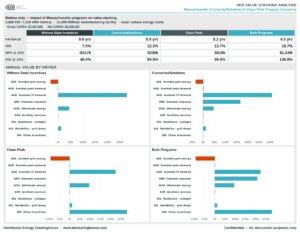
The battery-only case requires net capital of $2.31 million. Without program participation, the project remains marginal: 9.0-year payback, 7.0% IRR, and negative NPV of $417,000. By adding both programs the battery reaches a 4.0-year payback, 18.7% IRR, and $1.24 million NPV.
The takeaway is straightforward: in Massachusetts, the best distributed energy projects are not just installed behind the meter. They are designed around the hours when capacity, flexibility, and clean peak performance are worth the most.
Solar plus battery: more strategic, but more capital-intensive
The hybrid case is a different investment. It requires capital of $6.67 million versus $2.31 million for the battery-only case, and it must earn across more value streams to justify that spend.
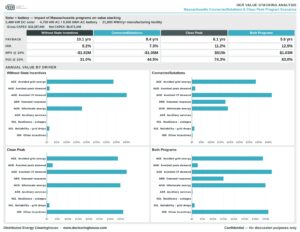
Without program participation, the solar-plus-storage project produces a 10.1-year payback, 5.2% IRR, and negative NPV of $1.82 million. With both programs, the modeled project delivers a 5.6-year payback, 12.5% IRR, and $1.03 million NPV.
That is not as financially interesting as the standalone battery case, but it is a broader platform: onsite renewable generation, demand management, wholesale energy value, and clean peak dispatch in one system.
What the value mix says about project design
The value stream mix matters because it shows why the economics change. In the “neither program” case, the battery is mostly a customer-bill management tool, with avoided customer peak demand doing most of the work. In the “both programs” case, the value stack broadens; demand-charge reduction still matters, but ConnectedSolutions, Clean Peak, and market participation add meaningful grid-facing revenue.
That shift is the central lesson. A battery optimized only for a customer’s monthly bill will not capture the same value as a battery co-optimized for facility peaks, utility events, Clean Peak windows, and wholesale market opportunities. The hardware may be the same, but the operating strategy is different.
The solar-plus-battery case tells a related story. Solar adds onsite generation and avoided energy value, while the battery adds flexibility. But the larger capital cost means the project needs more than ordinary bill savings to become financeable. In the modeled case, the hybrid project reaches positive NPV when Clean Peak participation is included, either alone or in combination with ConnectedSolutions.
For commercial customers, the practical question is not simply “battery or solar plus battery?” It is “which configuration can be operated to capture the values that matter most?” A standalone battery may offer the faster return where demand charges, incentive participation, and market opportunities are strong. A solar-plus-battery system may offer a broader long-term platform for energy cost control, clean energy use, and peak-period dispatch.
The strategic read
Massachusetts rewards DERs that are designed and operated around high-value hours. The best projects are not just installed behind the meter; they are managed as flexible grid assets.
For the modeled manufacturing facility, the battery-only case becomes compelling when the full value stack is used. The solar-plus-battery case requires Clean Peak participation to cross into positive NPV, but it also offers a broader energy strategy. In both cases, the conclusion is the same: program eligibility, dispatch strategy, and market participation should be part of project design from the start.