Generators Beyond Backup Power: Unlocking More Value
Commercial generators have traditionally been viewed as insurance against power outages. But in the right markets, they can potentially create financial value even when there is no emergency.
Reliable Backup
Peak Savings
Demand Response
Capacity Value
For decades, commercial generators have primarily been viewed as insurance. Businesses invest in them because the cost of losing power can be enormous. If the grid remains reliable, those generators may run only during testing, maintenance, or the occasional outage.
But the economics of distributed energy are changing. Depending on location, utility tariffs, operating restrictions, and market rules, a generator may offer opportunities to reduce electricity costs and participate in revenue-generating programs while continuing to provide essential backup power.
Watch: What Else Could Your Generator Be Worth?
In this DECH video, we explore how commercial generators can contribute to a broader distributed energy strategy by combining reliability with potential economic benefits.
Before thinking of a commercial generator simply as backup power, consider what else that asset could be worth.
From Insurance Policy to Productive Energy Asset
The traditional business case for a commercial generator is straightforward: protect the facility from the consequences of a power interruption.
That protection remains important. However, a generator may also be capable of providing financial benefits during periods when utility power is available.
Generator as Insurance
The primary purpose is keeping essential operations running during a power outage.
Operating hours may be limited to emergencies, testing, and maintenance.
Generator as an Energy Asset
The generator maintains its reliability role while potentially helping manage expensive demand periods and providing eligible grid services.
What Is the Full Value?
Which additional opportunities are available at the facility, and do their financial benefits outweigh operating costs and restrictions?
A commercial generator does not have to be viewed only as equipment waiting for the next outage. Where permitted and economically attractive, it can become part of a larger energy management strategy.
Three Ways Generators Can Create Financial Value
Beyond their reliability function, generators may deliver economic benefits through three important opportunities. Each depends on the characteristics of the facility and the rules of the local utility and electricity market.
Operating a generator during expensive peak-demand periods may help a facility reduce demand charges or other demand-related electricity costs.
In qualifying programs, a facility may receive payments for reducing grid electricity consumption or making flexible power available when requested.
In certain markets, strategically reducing grid demand during relevant peak periods may lower exposure to capacity-related charges.
These opportunities are not guaranteed or universally available. Program eligibility, generator operating limits, dispatch costs, and market conditions all influence whether they can be captured profitably.
The generator still provides the resilience and backup power that justified the investment in the first place.
The Opportunity Is in the Full Value Stack
The important point is that a generator’s potential value streams can sometimes be combined. Instead of evaluating backup power, demand savings, and market revenues as completely separate investment decisions, businesses can examine how those benefits work together.
However, a revenue opportunity that looks attractive on its own may compete with another opportunity for the same operating hours or available generator capacity.
Resilience
Demand Savings
Program Revenue
Capacity Savings
The goal is not to add every theoretical value stream together. It is to understand which benefits a generator can actually deliver under the site’s operating conditions and market rules.
Why Generator Economics Depend on Location
Two facilities with similar generators can have very different economic opportunities. The utility territory, applicable tariff, local market structure, and operating restrictions can materially change the value proposition.
Determines the local utility rules and service arrangements affecting the facility.
Influences how demand charges, peak periods, and other electricity costs are calculated.
Determines which demand-response or other revenue opportunities may be available.
Emissions requirements, permitted operating hours, and maintenance needs can limit dispatch.
Fuel, maintenance, and other operating expenses affect the net economic benefit.
The timing and magnitude of electricity demand influence potential savings.
A generator that delivers attractive savings at one facility may not produce the same result at another. Understanding the specific site’s electricity economics is essential before making an investment or changing how an existing generator operates.
Turning Potential Generator Value Into Better Investment Decisions
The challenge is not simply identifying possible value streams. It is determining which opportunities actually apply and what they may be worth.
Distributed Energy Clearinghouse helps businesses, energy consultants, and developers identify and quantify the potential value of generators, batteries, and solar across utility territories and power markets throughout the United States.
Identify the Facility
Evaluate Applicable Value Streams
Compare Economic Scenarios
Make More Informed Decisions
By bringing site-specific electricity costs and available market opportunities into a unified analytical framework, DECH makes it easier to evaluate how distributed energy technologies may contribute to a broader investment strategy.
Before you think about a generator simply as backup power, ask a different question: What else could this asset be worth?
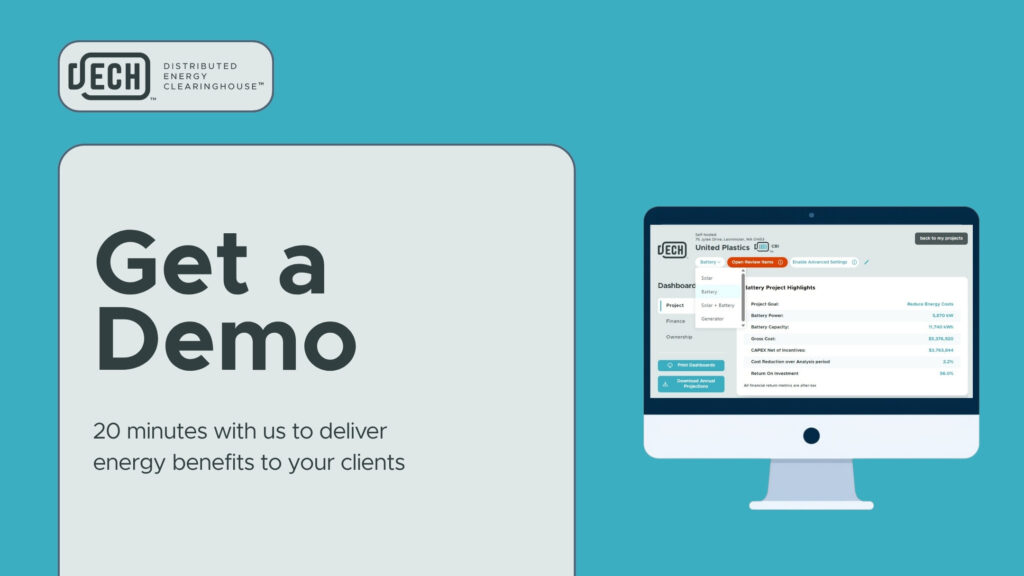
Discover the Full Value of Your Distributed Energy Assets
Schedule a DECH demonstration to explore potential generator, battery, and solar value streams for your facilities.
Prefer to explore subscription options? View DECH pricing and plans to learn more about available analytics packages.
Generator economics vary by site and market. Revenue opportunities and savings depend on program eligibility, utility tariffs, operating requirements, regulatory restrictions, and other project-specific factors. Potential value is not guaranteed.